Stage 1 notification
24 hours from awareness
Most of what a provider gets wrong is bookkeeping, not care.
Book a free 20-min meeting — written summary either way.
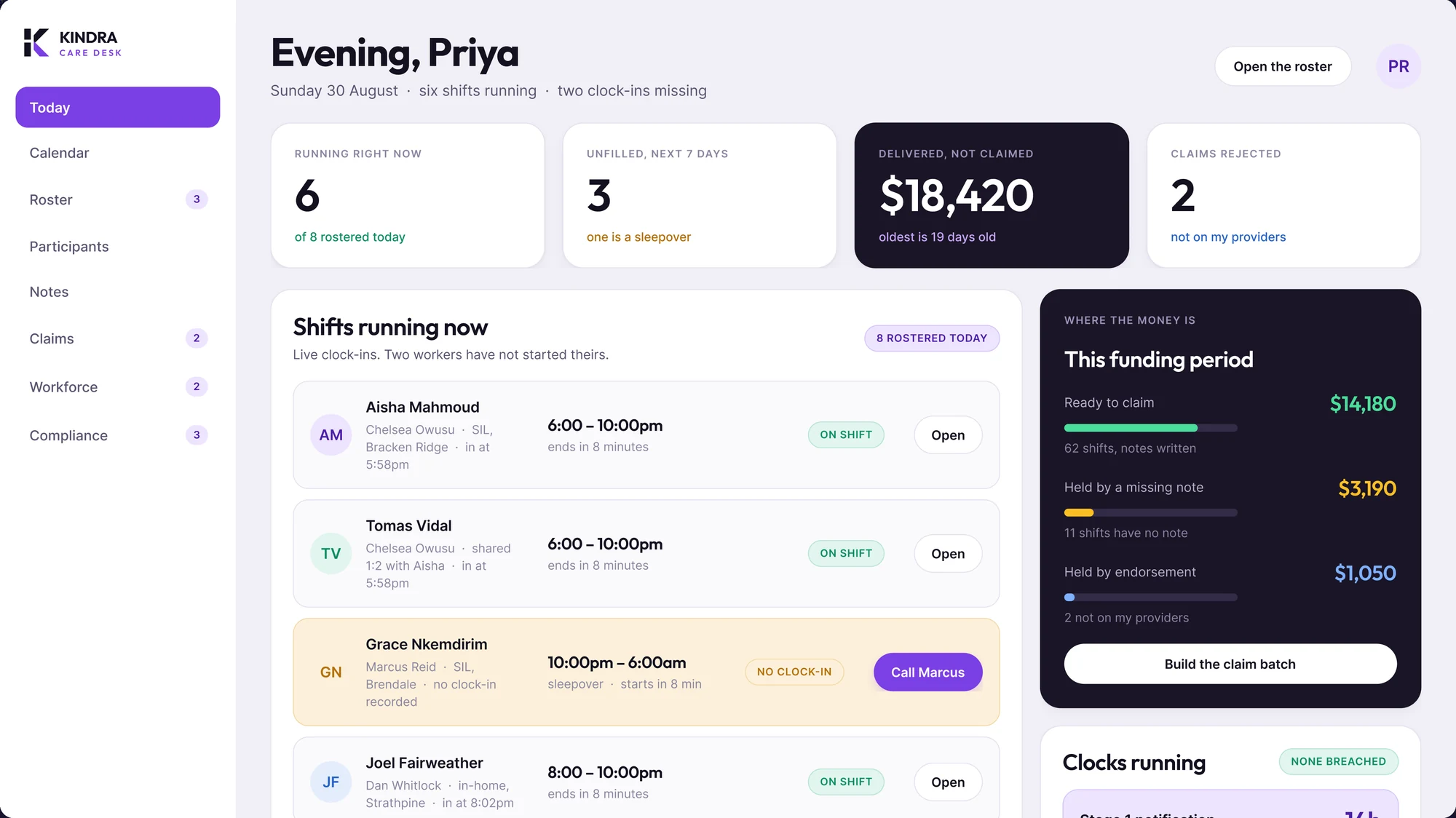
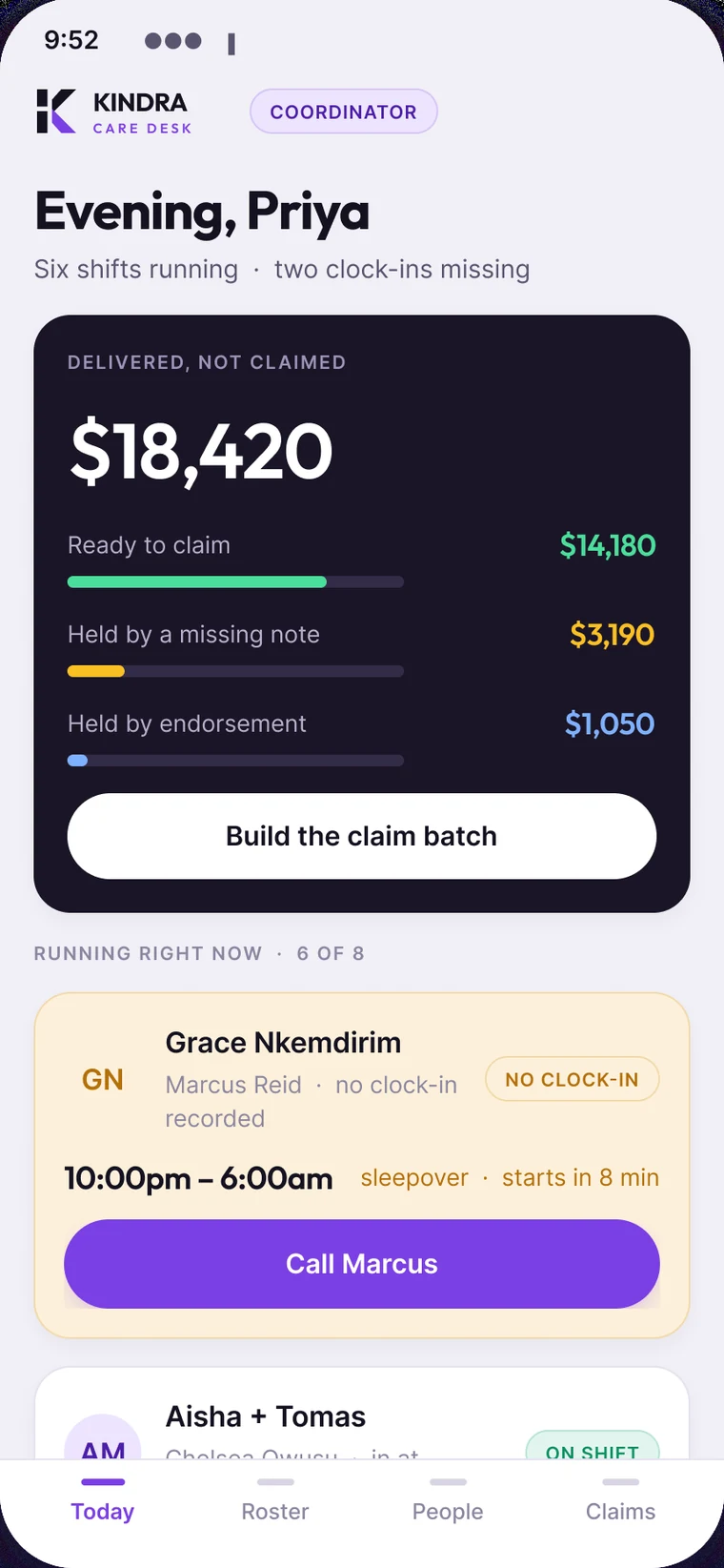
They are about what happens around it — and none of them are visible on an ordinary roster.
Under PACE there are no service bookings. Nothing reserves a participant's funding for you. A claim only lands if the shift ran, a note exists, and you are on that participant's my providers list for that support category. Miss one and it waits silently. Funding is released in periods too — unspent doesn't roll forward, so underspend is a live problem with a date on it.
A client cancels inside seven days and the worker is still paid. A sleepover is interrupted and the interruption is paid work. Morning and evening on one day is a broken shift. Under ten hours between engagements is a rest break breach. Rates rise every July. None of it shows on a normal roster.
Reportable incident deadlines run from the moment the provider became aware — not when it happened, not when the investigation finished. Counting from the wrong moment is itself the breach, and it is the most common notification failure in the sector.

When a worker raises an incident, the first field is when did you become aware. It is set by the system, it cannot be edited, and every deadline counts from it. Change it and the original stays visible as an amendment with a reason.
Restrictive practice where harm occurred is 24 hours, not 5 days. Telling the participant and their nominee is a Practice Standards requirement in its own right — the most commonly missed obligation in the sector, because notifying the Commission feels like the finish line.
Every other date in a compliance system is derived. If the moment of awareness is editable, every deadline downstream is editable, and the evidence pack stops being evidence.
So it is set by the clock when the report reaches you, it is immutable once saved, and an amendment never overwrites the original. An auditor can see both, and see who changed it and why.
The deadline is shown as a ring and plain words — due 9:40pm tomorrow — never a percentage and never a siren. In a disability services product, a red alert against a participant's name reads as blame.

Pick one from the list. Each is the real designed screen — click it to open it full size.
That objection is reasonable. So the boundary is built into the product rather than written into a policy — and it's shown on the surface, not buried in terms.
An auditor reads the entries, not the policy. A quality improvement register with no entries doesn't demonstrate compliance — it demonstrates the opposite. Care Desk shows you the empty one before they find it.

Permissions aren't a settings page nobody opens. They're part of the shape of the product.

A cohort of previously unregistered providers now has to produce evidence they have never had to produce before — and the evidence an auditor wants is a by-product of running the business properly, not a document you write the week before.

Not a demo reel. We go through where your claims are held, which SCHADS exceptions are sitting in this fortnight's roster, and what your registers look like to an auditor. If money's leaking on claims, roster, or unclaimed hours, we'll run a Leak Check in the meeting — it's a tool, not the booking name. You get a written summary either way.

The rest of the family
Same build, shaped for how that desk actually works — Care Desk is one lane. Rostering, notes, claims (or quoting, jobs, invoices in another trade). Built in Brisbane. Yours to own.